
Frequently Asked Questions
QUICK MENU
Practitioner engagement
in B-EAGER
Why is practitioner engagement in
B-EAGER important?
Practitioners are the ‘champions’ of the initiative. Their involvement helps enhance patient outcomes and quality of care, and build the evidence base to advance Bowen Therapy and Oncology Massage! The more practitioners that take part, the stronger B-EAGER becomes.
How can practitioners participate in
B-EAGER?
There are lots of ways to participate:
- Attending B-EAGER workshops and training
- Using PROMs in your practice (Patient Reported Outcome Measures)
- Sharing your data when requested
- Contributing to writing up Case Reports
- Staying engaged through opportunities and updates
- Joining the B-EAGER Steering Collaboration or sub-committees
- Opportunities will be advertised as Expressions of Interest
How will practitioners know when things are happening?
The easiest way to stay up to date is to register via the B-EAGER website (http://b-eager.org.au) — you’ll receive email notifications with news, opportunities, and invitations as soon as they are released.
You can also keep an eye on B-EAGER’s communication channels: The Bi-MonthlyB-EAGER Bulletin, our social media, and the website: http://b-eager.org.au.
If you have specific questions, you’re welcome to contact the B-EAGER team directly at info@b-eager.org.au.
Why are PROMs being implemented?
PROMs help practitioners collect more information about how their treatments affect clients and what is important to clients. This can improve the quality of care practitioners provide, resulting in improved outcomes and satisfaction for clients. PROMs information can also be used to highlight the benefits of Bowen Therapy and Oncology Massage treatment to other clients and practitioners in the health system.
Will practitioners use PROMs with every client?
Clients with conditions/symptoms that fall within the B-EAGER focus (priority) areas may be invited to complete PROMs questionnaires. Client participation is entirely voluntary, and they may withdraw their agreement at any time.
When will practitioners start using outcome measures, collecting data and writing case reports?
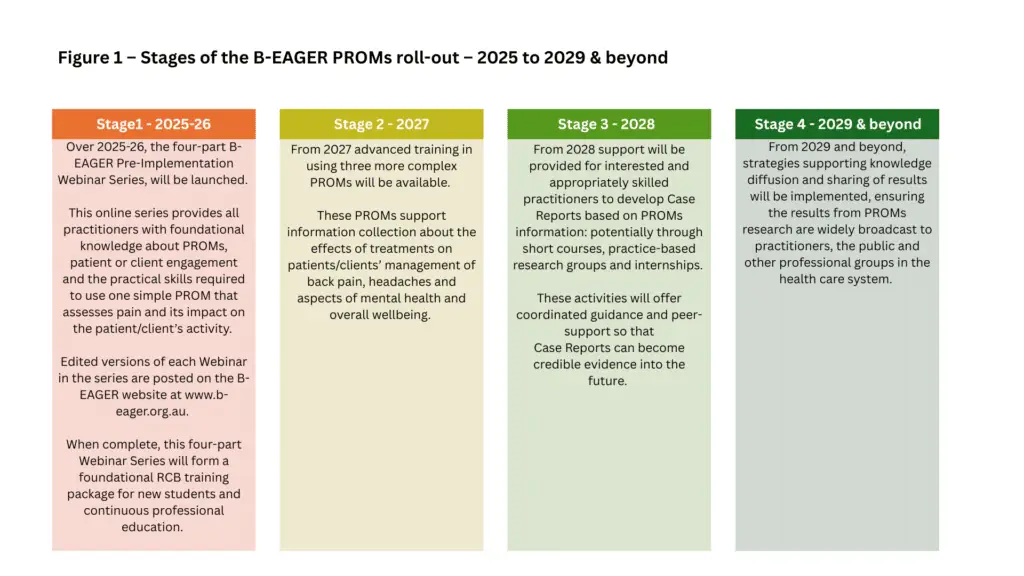
This activity will be staged.
B-EAGER is being rolled out in four phases: Establishment, Pre-Implementation, Implementation and Post-Implementation.
- Establishment Phase: Aug 2024 – late 2025, the team was focused on establishing the foundations — setting up the Steering committee and sub-committees and arrangements with stakeholders. This involved developing our aims and objectives, working on our modes of communication, action plans and our launch.
- Pre-Implementation Phase: late 2025 – late 2026 – This involves working to develop the B-EAGER Pre-Requisite training units, setting education standards, reviewing curriculum, creating resources (including a Practitioner Implementation Guide), and establishing practice-based research networks. This groundwork, done with the valuable input from our academic and industry partners, will ensure practitioners are well informed and supported when PROMs information collection begins.
- Implementation Phase: late 2026 – late 2027 – Once Pre-Implementation systems are in place, practitioners will be able to engage with using outcome measures, and ultimately case reporting and data submission, with confidence and consistency.
- Post-Implementation Phase: late 2027 & beyond – During this ongoing phase, the focus will be on monitoring and reviewing activity to ensure intended outcomes are being achieved. Modifications will be made to systems and activities as we learn more about what works best for our practitioners and clients. This phase will also focus on developing systems for sharing the results of our information collection with other health system stakeholders.
In the meantime, stay connected through the B-EAGER Bulletin, and take part in B-EAGER training and information webinars. Your involvement helps build the strength of the project when the implementation phase begins.
Will practitioners earn CPD points for working on the B-EAGER Initiative?
CPD (Continuing Professional Development) allocations will be determined by each participating organisation (e.g., BAA, BTFA, BTA, OMG, FK, BTNZ & MMA). You may be eligible for CPDs for activities such as Pre-Requisite training, case report writing or data entry. Final arrangements are still being developed and will be communicated once confirmed. CPD aside, practitioners engaging in B-EAGER activity will be contributing to the long-term sustainability of their profession.
Organisational involvement
in B-EAGER
Can other organisations join the B-EAGER collaboration?
Yes. We welcome interested organisations joining our collaboration, where there are shared goals and mutual interests. We are keen to collaborate or network with like-minded Professional Associations, Education & Training Organisations, Industry Partners and Academic Institutions. Please contact the B-EAGER Initiative Steering Collaboration via email at info@b-eager.org.au if you would like to discuss your interest in joining us.
Priority areas for B-EAGER research and data collection
How were the B-EAGER priority areas chosen?
The B-EAGER priority areas were chosen because they are areas commonly treated by Bowen therapists and Oncology Massage practitioners that align with National Health Priority areas. By focusing on National Health Priorities related to our practice, we’re building evidence of national interest that can demonstrate the value of our therapies to government, policymakers, and the broader health sector. Focusing on specific areas helps to quickly generate a body of research data. It can also build workforce confidence, create consistency, and generate the kind of evidence that will be the most persuasive.
Can practitioners contribute to the B-EAGER research if their area of interest isn’t one of the five priority areas?
Yes — but here’s how it works.
B-EAGER is designed as a 10-year strategy, and in the first 3–5 years, the focus for research will be on the priority areas.
These were chosen because they are
a) areas commonly treated by practitioners and
b) areas governments and other health professions are most interested in right now.
Keeping our energy and resources focused on researching the priority areas at first will help develop a critical mass of information quickly; however, over time, more research areas can be explored as our workforce research capacity grows.
What does “Mental Health: Wellbeing + Function” mean?
The B-EAGER Initiative focuses on aspects of Mental Health that are commonly seen by Bowen therapy and Oncology Massage practitioners.
These are associated with clients’
- a) Wellbeing. contributing to the management of stress, anxiety, depression, etc.
- b) Physical and social functioning. ability to exercise, engage positively in tasks and activities associated with daily living, such as work, social activity, decision making, etc.
Why were anxiety and stress management included as information collection priority areas?
These areas relate to Mental Health and Wellbeing, which are national health priority areas in Australia, New Zealand and internationally.
They are highly relevant to treatment approaches for both Bowen Therapy and Oncology Massage.
Anxiety and stress management can be measured and tracked through existing PROMs, and this makes them a valuable focus area for case reporting for both professions.
Data collection and Case reports
How will the B-EAGER data be used?
The B-EAGER data will be used to develop many resources, such as:
- client-centred and individualised treatment plans
- client information brochures and web-based materials
- referral information for other health system providers
- a range of marketing, informational and communication tools
- conference presentations and seminar materials
- case reports
- publications in peer-reviewed journals
Practitioners, academics, and clients will be involved in developing these resources.
Who are the main audiences for the results of B-EAGER information?
Practitioners and their clients will be the main audiences initially. Information will be used in clinics to enhance existing information collected about clients’ conditions, symptoms, treatment plans and satisfaction with their care.
Over time, we will focus on using information to improve care across our profession and influence other health care providers, like doctors, physiotherapists, osteopaths, occupational therapists, chiropractors, naturopaths, etc., as well as current and potential clients.
We will also explore opportunities to advocate to governments, local, state and national, professional bodies and academics.
What are the consent requirements for using client data in case reports?
Client consent is required for any identifiable or case-specific data used in research.
B-EAGER will provide consent templates, information brochures for patients and training to help practitioners collect and use data ethically, rigorously and responsibly. This is part of the Implementation phase of the B-EAGER rollout.
How will case reports from practitioners trained in different schools be handled?
This issue can be managed through data analysis. Differences between training approaches can be acknowledged and respected.
A mapping process is already underway to align terminology and techniques across collaborating schools. This will allow data to be grouped meaningfully while celebrating individual styles.
Diversity in practice will be documented clearly, and outcome-based reporting will reflect both shared practices and nuanced variations.
Will there be a dedicated platform for collecting PROMs and case report data?
Initially practitioners using PROMs will be required to maintain information within their clinic and patient files. Information about how to go about this will be provided in the B-EAGER Practitioner Implementation Guide.
Establishing more complex information collection and collation approaches is part of future B-EAGER development phases. B-EAGER is working in partnership with ARCCIM, and industry partners to co-design and implement practical, secure systems for PROMs and case report data collection. Feedback and input from practitioners will help shape these systems.
How much ‘weight’ will Case Reports carry as a form of research to influence others?
Case Reports are an important foundation in the research landscape, and they often serve as the first source of new observations, questions, and ideas. When multiple Case Reports highlight similar patterns, they can build into a Case Series — adding credibility and drawing attention to emerging trends.
They provide practitioners with a useful tool to share clinical insights and observed outcomes, while also capturing the client’s experience of treatment in a recognised and credible format.
Health rebates and B-EAGER
Will B-EAGER help clients regain health rebates?
This is not the focus of the B-EAGER Initiative, however, because B-EAGER aims to build our profession’s research capacity and support us in generating more evidence about Bowen therapy and Oncology massage, it will, in time, help us be in a better position than we have been before to be considered for recognition, if that opportunity ever comes along again.
Other
What is Research Capacity Building [RCB]?
RCB is a multi-faceted process focused on enhancing the ability of individuals and organisations to engage with and ultimately conduct high-quality research. It involves developing skills, improving infrastructure and fostering collaborations to strengthen a research culture. This ensures that research investment and efforts can continue to thrive over time.
Can B-EAGER apply for research grants as a not-for-profit?
No, not research grants, as these are awarded to universities and research institutions that have the academic leadership, expertise, and systems needed to undertake the research and manage the grant.
However, associations involved in B-EAGER may be eligible for other kinds of funding, such as education or capacity-building grants. Partnerships with academic institutions and Industry partners can allow for joint applications in the future.